Element 1 Student Self-Regulation#
Across the unit, I intentionally structured tasks to strengthen students’ ability to monitor their progress, take responsibility for learning, and engage independently with Japanese language content. where they will know when their learning is to be achieved, they will take responsibility for learning, and mastery will be expected regarding Japanese language topics. At least on some measure, the Mystery Box task, according to L2-V1, helped the students develop this sense. This activity was not interactive but demanded clue judgment through vocabulary and speaking or listening at the right moment. The peer feedback noted about L2-E2 to L2-E4 was on the improvement of these two aspects. Playing games improves metacognitive monitoring: strategies are selected, outcomes analyzed, and results judged (Edutopia, 2023). The episode of character learning then bears out this modeling and functional meaning as a learning source: Stroke order thus becomes modeled, and character use is understood from etymology; the children write modeled characters using hints. Self-completion and copy works met with self-correction evidences the developing capacity to judge the quality of work and adjust behavior by itself without any teacher input. Coherently with Zimmerman’s (2002), modeled teaching to a certain extent and guided practice is supposed to provide grounds for developing cycles of learned self-regulated learning.
The support given in multilingual support L1-E6 will indeed be a self-regulation aid to learners in subsequent pairing work. From the available annotations, the sheet’s objective was not to provide answers but rather to avoid passing into despair and continue in the implicit participation and persistence modes of the tasks. Therefore, the withdrawal of teacher mediation calls for the productive role of mediation in fostering autonomy and agency as students attempt to resolve emerging problems.
Also, this would explain why most facilitate students’ self-regulation in L4, where the most complex organizational problems are of a unit nature not to concern timing and rotation of responsibilities for clarifying meaning but repair in Japanese and English. These are modifications, repetitions of essential expressions, and requests for referring to notes taken in previous lessons, exhibiting strategic self-regulation. Thus, according to Edutopia (2022), this is indeed an area that per se represents a consolidation of long-term self-regulation habits through tasks establishing autonomous work and excellent interaction stimulated by students.
At this point, gradual self-regulation could continue only by applying explicit self-assessment sheets and reflection stems post-key units: Why and What? Thus, the students would have to explain their results. This ignites an interest in metacognition and makes students effective autonomous language learners.
Element 2 Engagement#
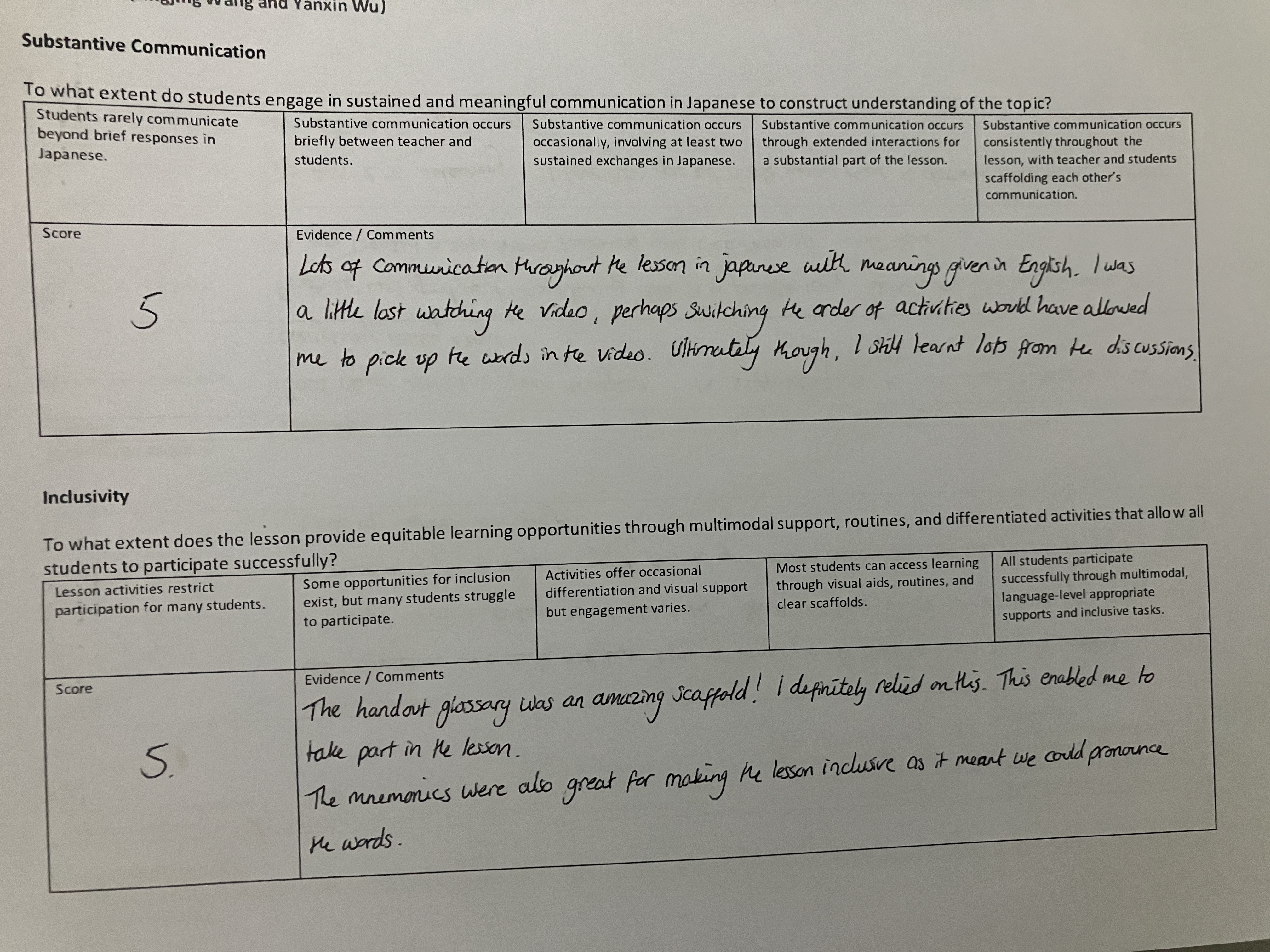
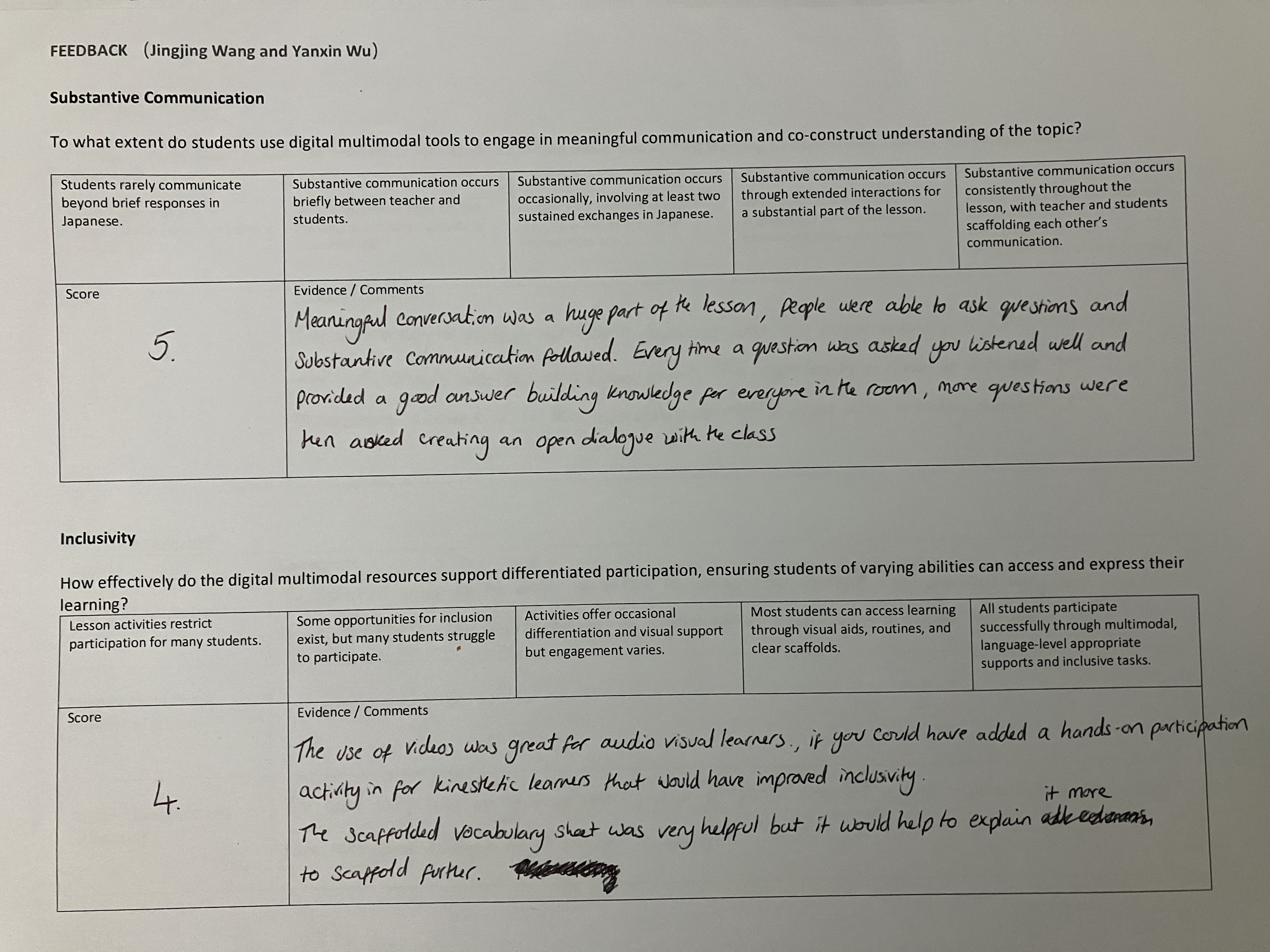
One of the most successful means of engagement was the Mystery Box activity L2-V1: surprise, movement, and peer interaction created high energy and thus deep involvement. Peer comments L2-E2 to L2-E4 systematically record the fact that “ready to guess,” “focused,” and “actively listening to peers” mean that the activity, appropriately designed, captured their attention and kept them interested. Looking at the openness of the guessing process, the discovery that every learner has an idea to share means that engagement would have had a longer duration than merely one instant.
Similarly, cultural hooks were purposefully used to further implicate learners in engagement. For example, hearing the term itadakimasu and gochisousama accompanied by visual aids and explanations L1-E6 to L1-E10 made learners aware of the etiquette in the Japanese language, which was novel but also appropriate to their discovery process. The affordance of emotional and cultural context allowed learning to be heated and to allow meaningful learning, implying student engagement. Students stated the reasons for engagement: “being curious about Japanese culture”; that is, engagement based on meaning over compliance. Lesson 3’s kanji sequence L3-V1 added a different dimension of engagement by integrating visual modelling, cultural storytelling about character origins, and hands-on practice. Student work samples L3-E2 to L3-E4 show that learners were not only attempting the kanji but also experimenting with form and structure, reflecting cognitive engagement with the writing system. The interplay between visual explanation and personal practice supported sustained attention throughout the activity.
Finally, Lesson 4 involvement randomised Japanese 抽選器 for grouping L4-V1, an aspect of cultural novelty, randomness, to invigorate students further in the activity. When asked about the random group, students liked the “picking” part. In turn, interview data support that the students within the created groups remained motivated to work throughout the task L4-E1 to L4-E3. This is evidence of affective engagement: students attend because the activity is meaningful and fun.
This will be an area for improvement in engagement in subsequent iterations by introducing explicit choice-pathways of alternative task formats or themes, thus allowing the learners more autonomy in learning. This would improve intrinsic motivation and allow deeper cognitive engagement.
Evidence#
L1-E6 Mealtime Etiquette Support Sheet#
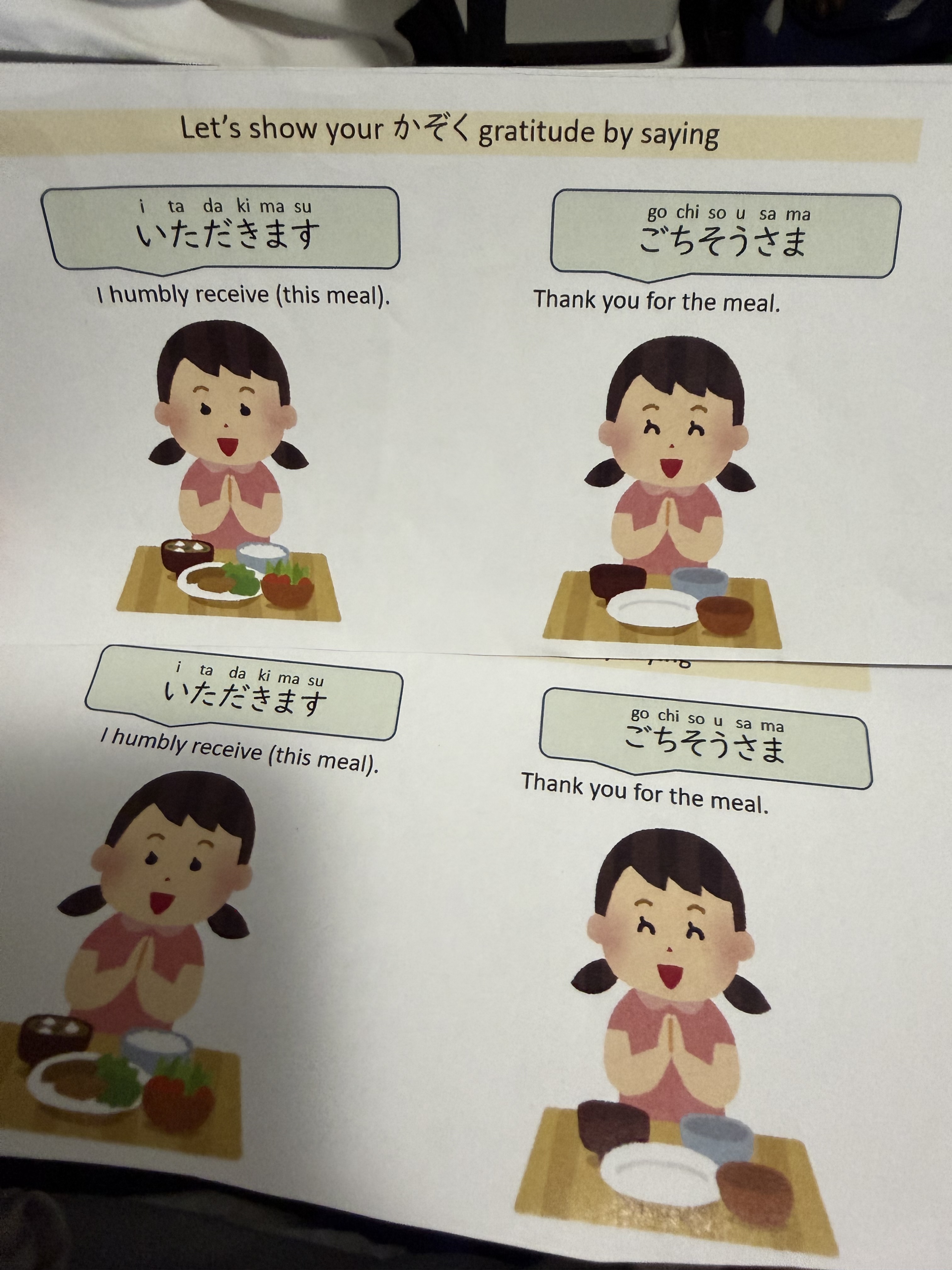
Provided structured language support that reduced anxiety and enabled students to persist independently during pair work—supporting emerging self-regulation.
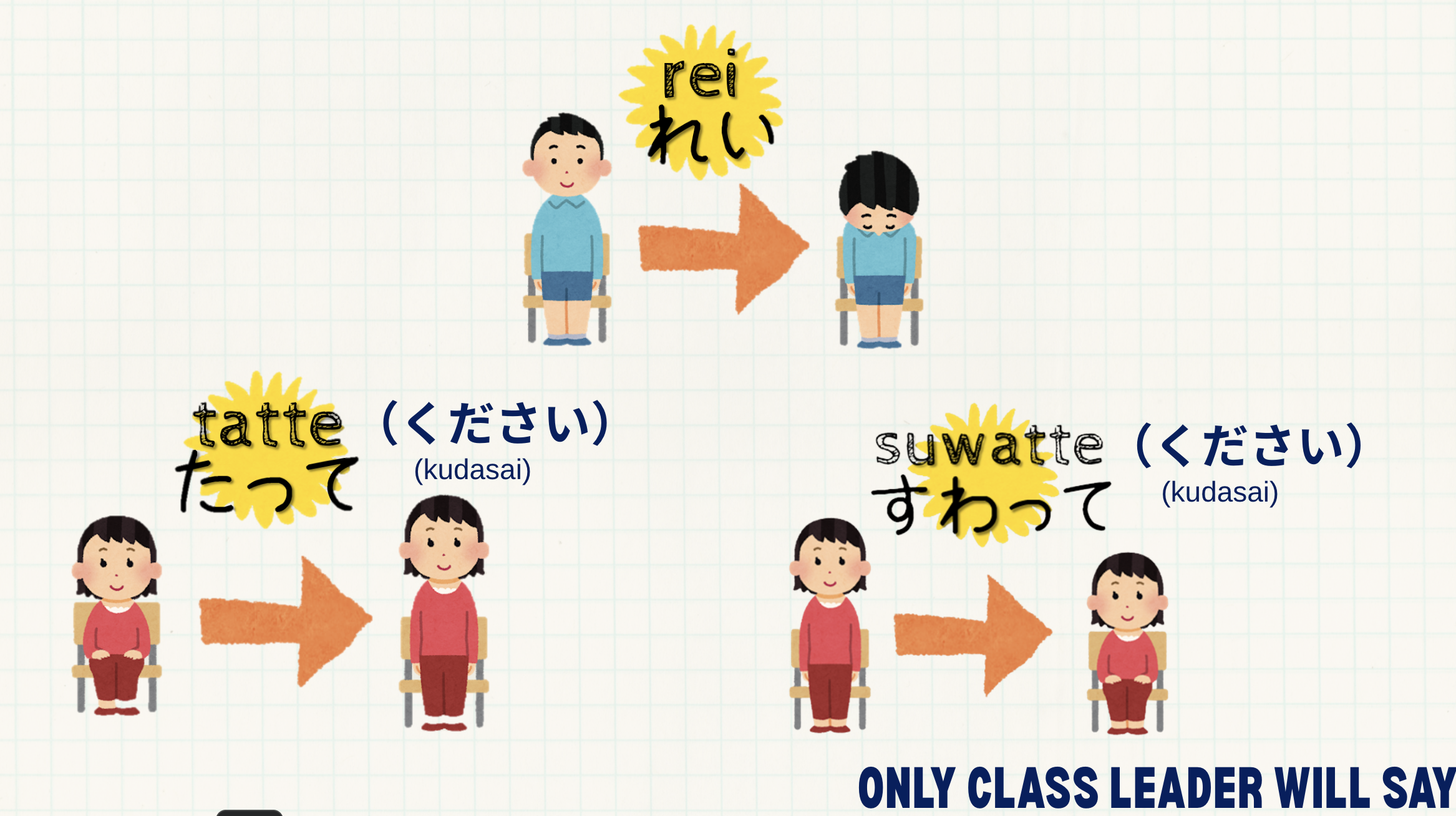
L1-E8 Classroom Etiquette Poster#
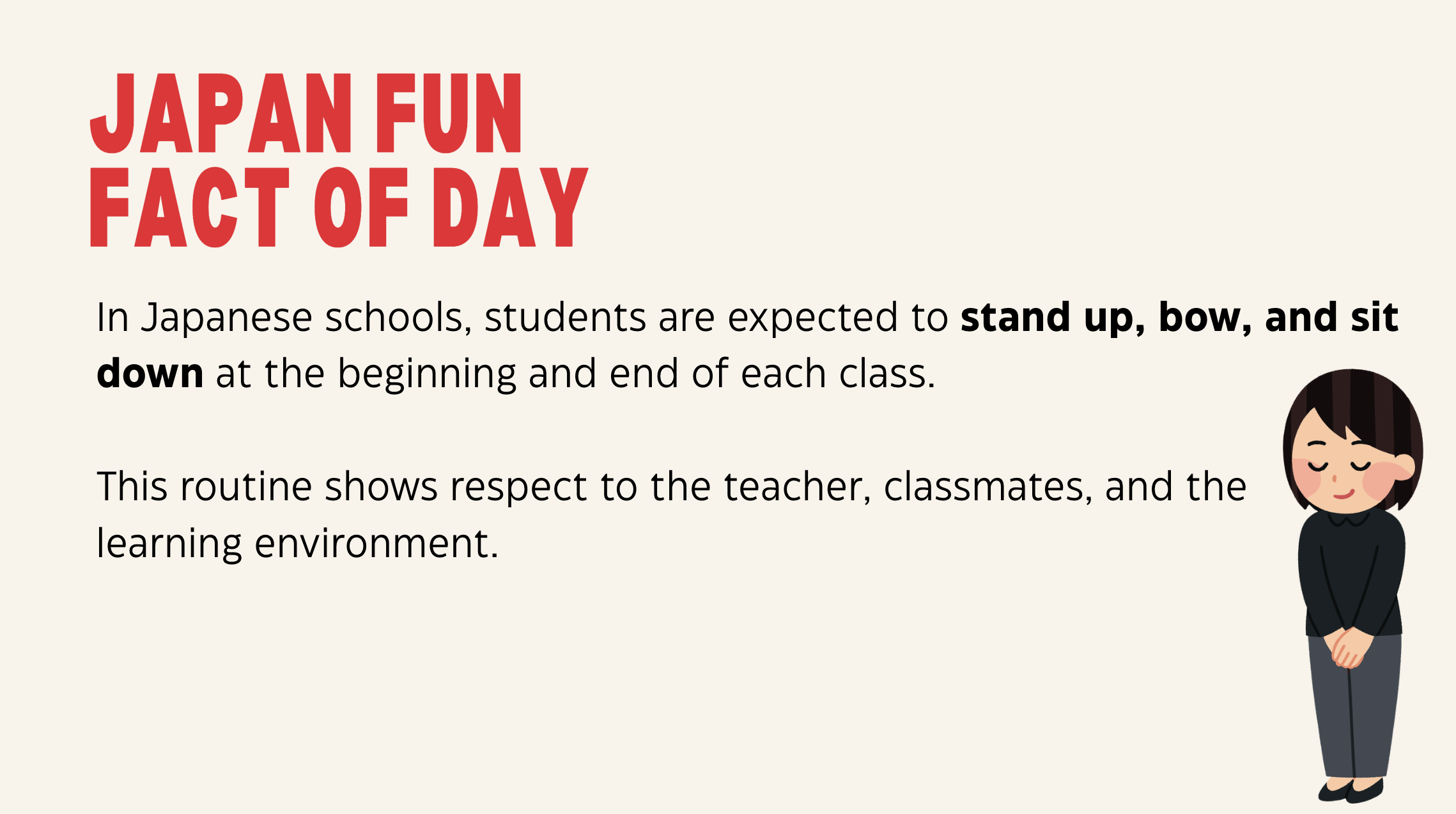
Helped students recall appropriate cultural phrases and regulate responses during class interaction.
L1-E9 Classroom Etiquette Poster#
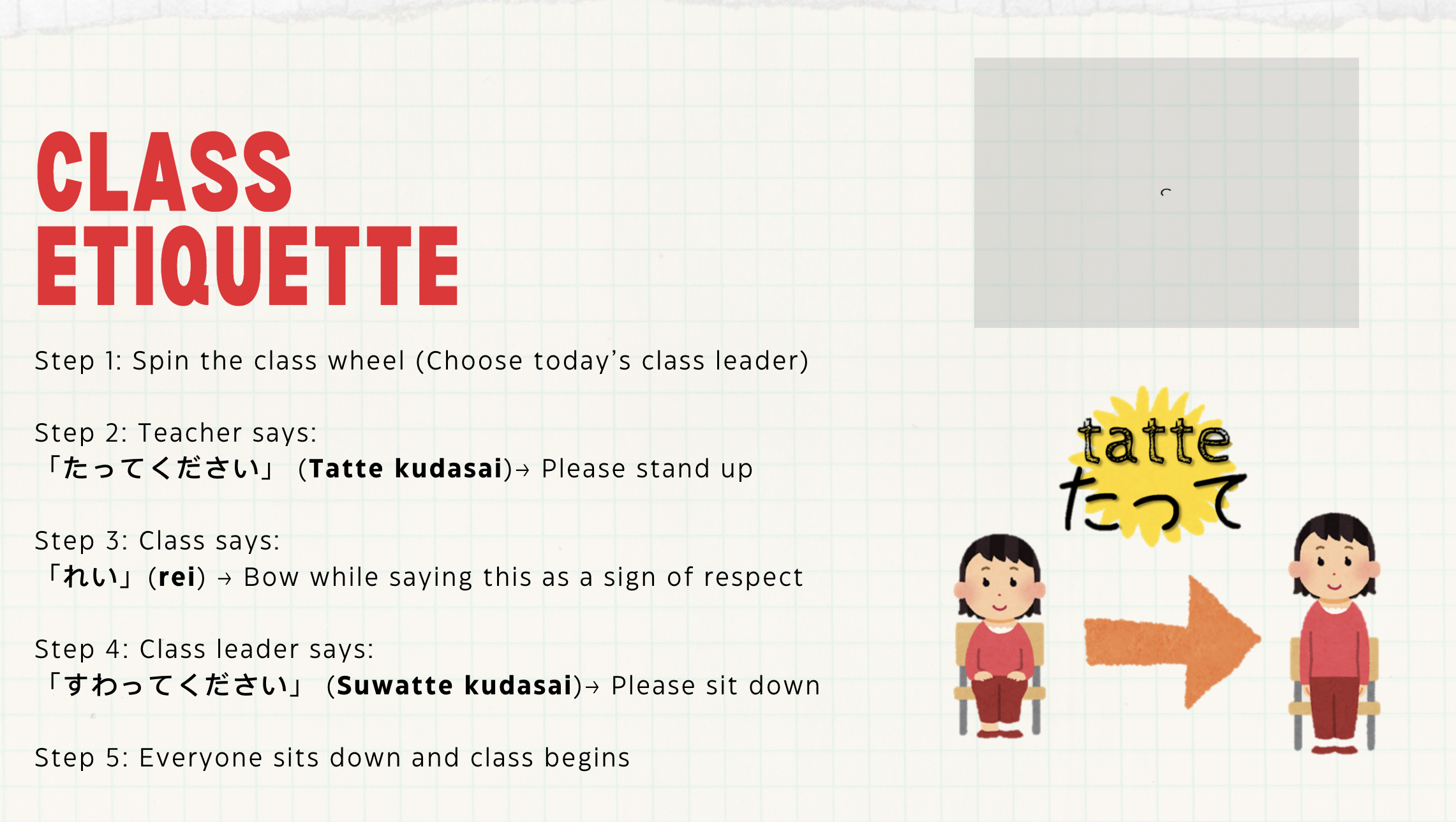
L1-E10 Classroom Etiquette Poster#
L2-V1 Mystery Box Family Game (Video)#
Students practised Japanese family vocabulary using a “mystery box” guessing game.
L2-E2 Peer Feedback Sample#
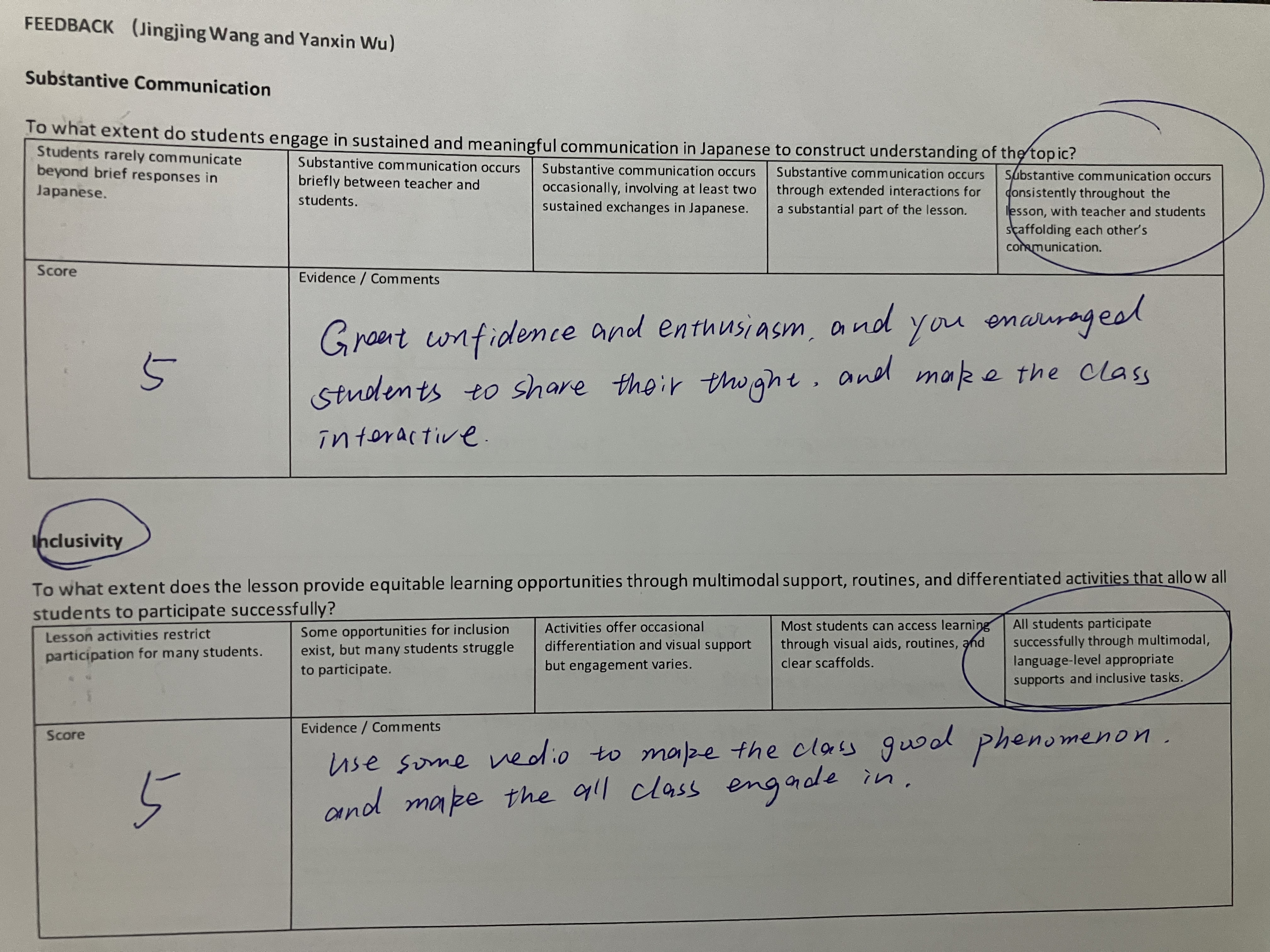
Students noted they were “ready to guess” and “actively listening,” providing evidence of cognitive and affective engagement.
L2-E3 Peer Feedback Sample#
L2-E4 Peer Feedback Sample#
L3-V1 Kanji Demonstration (Video)#
This video shows the teacher’s explicit modelling of kanji structure, demonstrating the stroke order and visual origins of 母 and 父 from ancient script to modern Japanese.
L3-E2 Student Kanji Sample#

Shows students independently applying stroke-order modelling, demonstrating self-regulated practice.
L3-E3 Student Kanji Sample#

L3-E4 Student Kanji Sample#
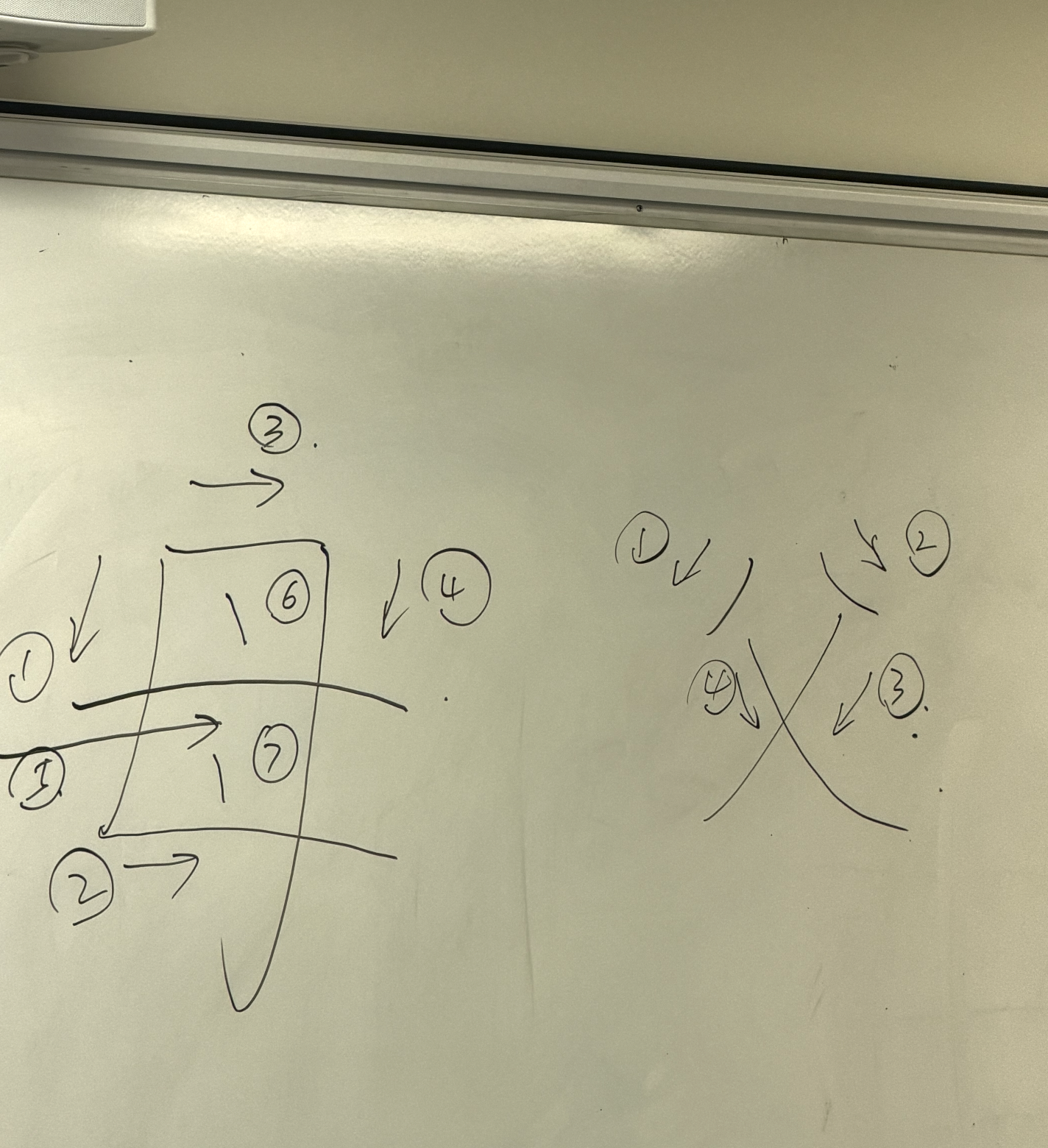
L4-V1 Family Interview Activity (Video)#
Introduced the Japanese 抽選器 (chūsenki) for random grouping before conducting family interviews.
L4-E1 Interview Template#
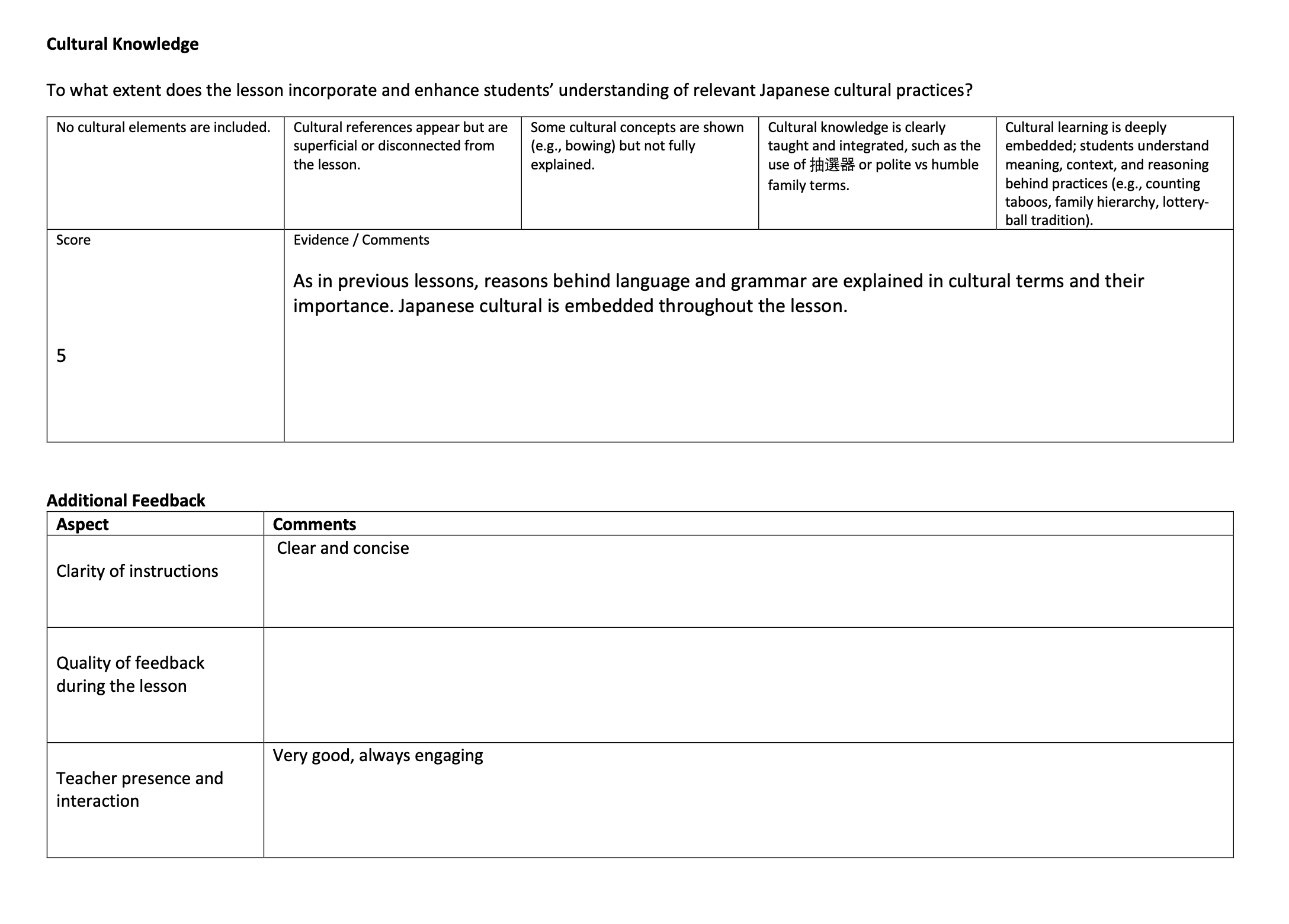
Student work demonstrates self-directed use of notes, repetition, and repair strategies—evidence of maturing self-regulation.
L4-E2 Interview Template#
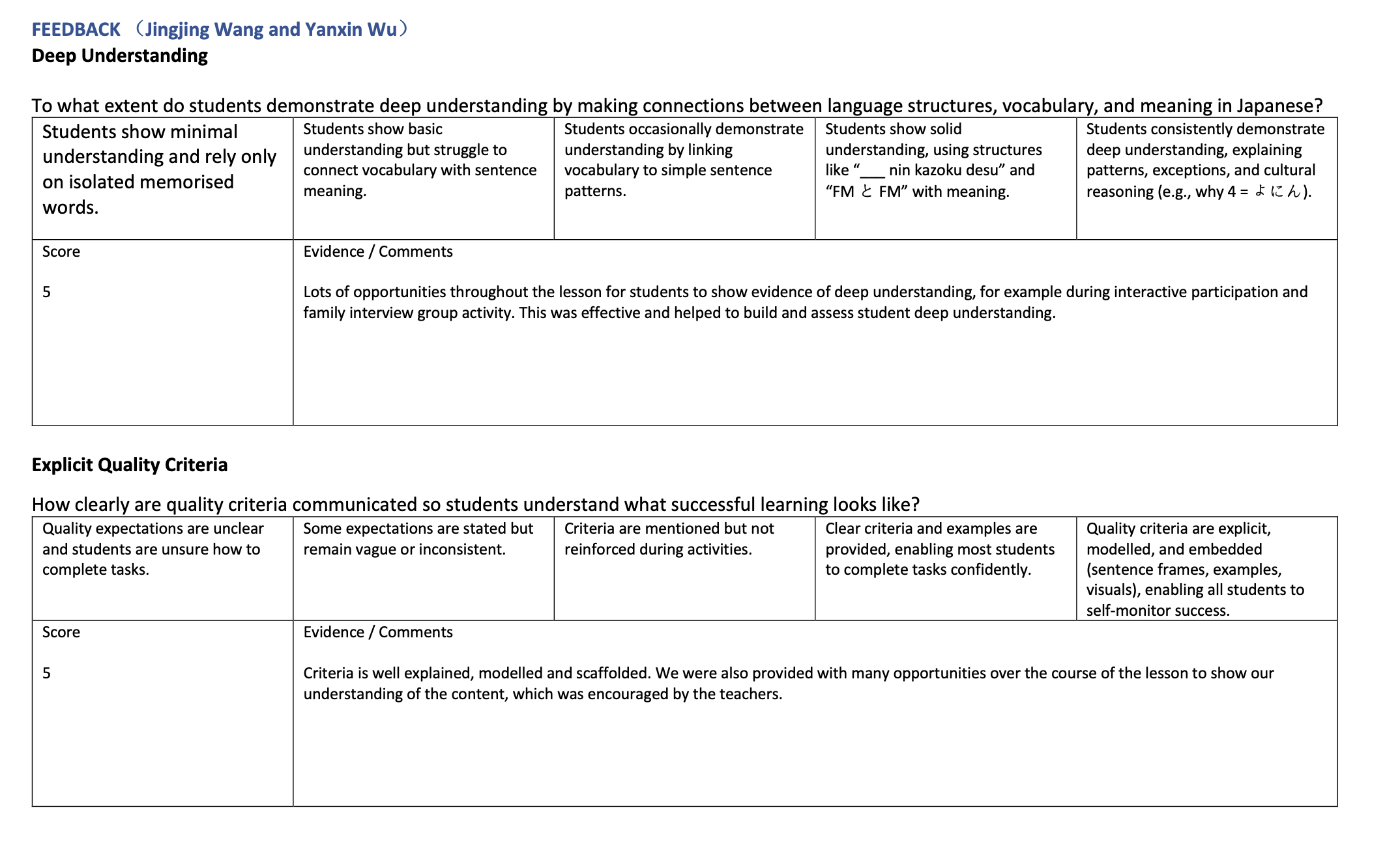
L4-E3 Interview Template#